Category Archives: Disease

Mighty Mato Tomatoes and other Favorites!

People, people. Lend me your ear! This may be just what the “doctor ordered”! What more could we who live in the desert southwest ask for!

I know how much work I do just so my dirt (can hardly call it soil) can hold water and praying that I can afford the fertilizer and water needed to allow a plant to grow, let alone flourish!

If you know what I’m talking about… this product is for you!

The ideal discription of a plant that is made for our environment is as follows… Can better tolerate temperature extremes, Can grow in poor soil, more resistant to pathogens, can produce up to 4 times the normal yield. This description could only be better if it were self-watering, self-pruning and free!

Introducing the “Mighty Mato” and other grafted fruits and vegetables.

Once again the Mesquite Valley Growers has introduced to me a wonderful and new (to me) product that I am h20140603-213435-77675385.jpgaving my first experience with and though it is too soon to state conclusively my total experience with the product, I am glade to share with you my experience so far.
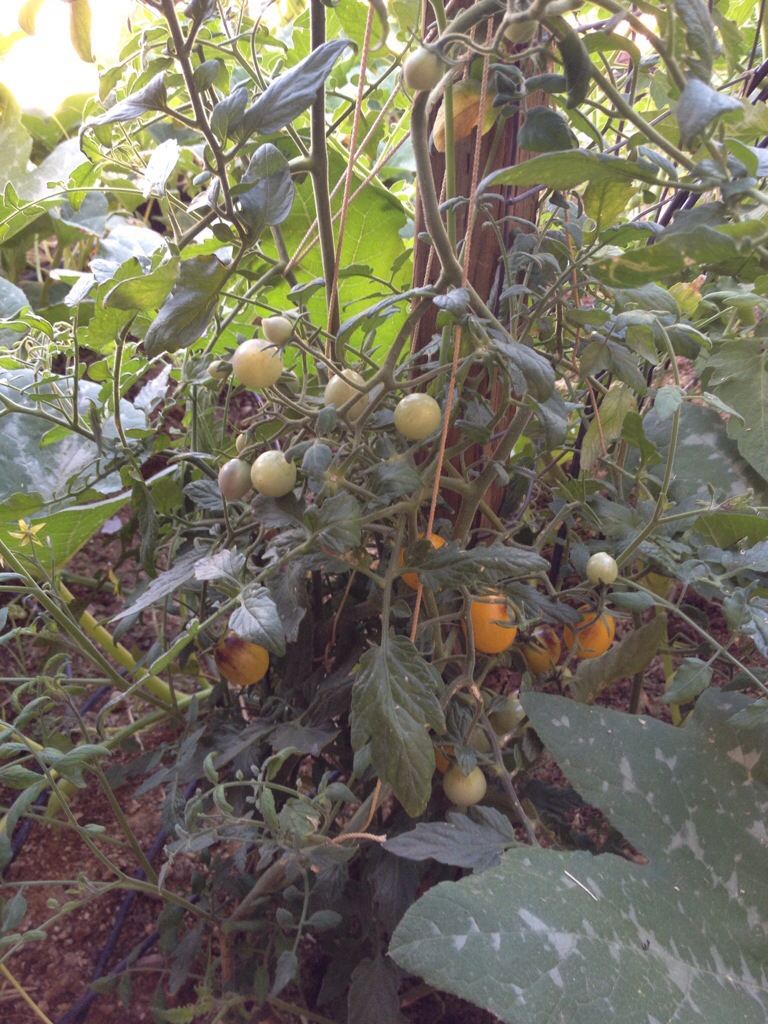
The seedling that I purchased was filled with fruit, multiple secondaries established within the first few inches of the base of the primary, all sturdy and comparable in size as the main. Flower buds showing and no indication that the flowers and the subsequent fruit would be a burden or overly task the plant.

I planted next to a 6pack of sweet one hundred which are on the my heavy water supply irrigation plan as are the rest of my tomatoes, squash and cucumbers. You may wonder what my “heavy water supply” actually equates to! Well I wonder also! I could figure it out but the facts would mean very little since there are so many factors that would determine the amount of water you will require and my requirement is certain to be difference than nearly everyone else.

Use the site search or use Google 0r other search engine to find more information about watering.

Beans Update

Ok, admitedly, you can’t grow all things well.  It seems that everyone has a speciality.  Mine is tomatoes, or broccoli maybe, but certainly not beans.  I have been harvesting my pole & bush beans for about 3 weeks now and it looks like they are just about done.  I’ve gotten perhaps enough for a family of 6 to eat at a single meal.  And not all harvested at once.  Perhaps a handfull a day, at best.  Plus, there were wild temperature fluctuations….two nights of near freezing, and daytime record highs, that caused an uncontrollable case of powdery mildew, which ultimately is causing the premature demise of the entire bean crop.  There was the huge attraction of the mice and birds to the bean seeds, and Itty was useless as a deterrant, in fact, she enjoyed digging the seeds up herself.  Traitor.  Do I sound bitter?  It’ll take a couple of weeks for the sting of this defeat to melt into a distant memory.  Meanwhile, perhaps there are lessons to be learned here.  For one, I don’t usually have disease as a foe, so the experience of dealing with powdery mildew was a good thing to learn.  (That, spraying the beans three days in a row will knock it out before it becomes a big problem.)  And then, there is always the big one….preparing the soil. This is usually where I beat the battles before they begin.  Stronger plants, more disease resistance, and larger yields can all be traced back to good dirt.  The last thing I’m gleaning from my bean experience is the silver lining…..even if the bean crop was a failure, beans still fix nitrogen in the soil, so the planting that follows my failed crop next spring will be much better off because the beans grew there.

 
ps.  I will try beans again, but not until I’m in a happier place.

Nourishing The Garden Soil

It would be ideal, but I don’t have a compost pile.  I have field mice and critters that would love a winter home like that, so my options are somewhat narrowed when it comes to adding organic matter back into my garden soil.  What I have decided to do is to plant a cover crop.  I’m not sure yet how often I’ll need to do this, my research isn’t complete yet regarding the required timing for home gardens, but field crops do it at least every 3 years, some more often than that.  There are plenty of choices and each of them adds organic matter, replenishes soil nutrients, supresses weeds, breaks up pest and disease cycles, and encourages soil integrity.  There is life in the soil folks, and it needs to be protected.   You can use grass or legume cover crops to accomplish this.

Oats are a grass cover crop which absorb and store nutrients and protect bare ground with the dead mulch they leave behind….and they don’t require turning over.  In a “low-till” garden they are ideal since you only turn the ground over if you desire or even just rake the residue before planting… in fact, they don’t even need to decompose before planting the next crop.  How easy is that?

Winter Rye.  Another grass cover crop that gardeners use because it’s hardy.  Rye has a thick tangle of roots and tough stalks that adds lots of organic matter to the soil.  About 3 weeks before you’re gonna plant, just turn it into the soil to decompose and release the nutrients for your crop to be.

Legumes are my favorite cover crops.  They give the soil a nutrient recharge so very needed.  Crimson Clover, Winter Peas, and Hairy Vetch are common legume cover crops. 

Hairy Vetch is particulary attractive to me because it is a prolific nitrogen producer.  It has even been shown to have a Nitrogen fertilizer replacement value of 80 pounds of Nitrogen per acre in some studies….which means less fertilizer needed….which means less money spent.  Now we’re talking my language.  I’ve read that it can be incorporated before flowering (to prevent reseeding) or after flowering…..your choice. 

Any way you look at cover crops they nourish the garden and give the spring planting a stronger start.

Dissimilar Planting, Over-water and Disease

Plant compatibility has many aspects to consider. This post addresses the issues that I experienced associated with the proximity between peppers and tomatoes.

Taking from the ideas of “Square Foot Gardening” I attempted to maximize my limited space by alternating and nestling my pepper rows between my tomatoes. The idea was that I new the tomato plants would require a significant amount of space on both sides for maintenance and harvesting and that the peppers which would not occupy much space could coexist near and on one side of each row of tomatoes. This plan, at first had great merit and immediate benefit but as the season wore on it became clear that this was not the best idea. Continue reading Dissimilar Planting, Over-water and Disease →